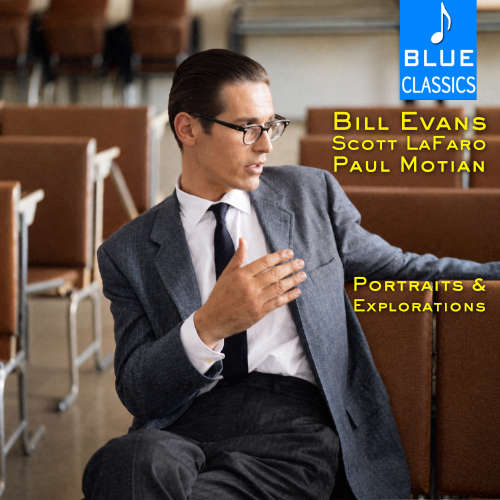
Title: PORTRAITS EXPLORATIONS
Year: 1961
Category: JAZZ,PIANO,BLUECLASSICS
- 1. Come Rain or Come Shine 03:20
- 2. Autumn Leaves 05:58
- 3. Witchcraft 04:33
- 4. When I Fall in Love 04:54
- 5. Peri's Scope 03:14
- 6. What Is This Thing Called Love? 04:35
- 7. Spring Is Here 05:06
- 8. Someday My Prince Will Come 04:53
- 9. Blue in Green 05:24
- 10. Israel 06:11
- 11. Haunted Heart 03:26
- 12. Beautiful Love 05:04
- 13. Elsa 05:08
- 14. Nardis 05:50
- 15. How Deep Is the Ocean? 03:32
- 16. I Wish I Knew 04:40
- 17. Sweet and Lovely 05:55
- Bill Evans – piano
Scott LaFaro – bass
Paul Motian – drums
Tracks 1-9:
Recorded December 28, 1959, Reeves Sound Studios, New York City
Tracks 10-17:
Recorded February 2, 1961, Bell Sound Studios, New York City

PORTRAITS EXPLORATIONS
by Bill Evans with Scott LaFaro, Paul Motian
The recordings gathered here document the Bill Evans Trio with Scott LaFaro and Paul Motian across two studio sessions separated by just over a year. The first, recorded on December 28, 1959, produced Portrait in Jazz. The second, recorded on February 2, 1961, became Explorations. Between these sessions the trio developed a distinctive conception of piano-trio playing in which piano, bass and drums functioned not simply as melody, harmony and accompaniment, but as three continuously interacting voices.
The trio was formed in 1959, following Evans’s work with Miles Davis and his departure from the Davis Sextet. Scott LaFaro, already an accomplished young bassist, and Paul Motian, whose playing had attracted Evans’s attention through their earlier work together, became the two musicians with whom Evans developed his new trio concept. Their first major studio statement was Portrait in Jazz, recorded for Riverside at Reeves Sound Studios in New York on December 28, 1959. Orrin Keepnews produced the session, with Jack Higgins as recording engineer.
The repertoire of Portrait in Jazz already reveals much about Evans's approach. Rather than relying primarily on newly written jazz material, the trio worked extensively with songs from the American popular repertoire: Harold Arlen and Johnny Mercer’s “Come Rain or Come Shine,” Joseph Kosma’s “Autumn Leaves,” Cy Coleman’s “Witchcraft,” Victor Young’s “When I Fall in Love,” Cole Porter’s “What Is This Thing Called Love?” and Rodgers and Hart’s “Spring Is Here.” Alongside these standards are Evans’s own “Peri’s Scope” and the Davis/Evans composition “Blue in Green.”
The arrangements are notably open. Evans does not simply state a melody and accompany a soloist; the piano, bass and drums continually respond to one another. LaFaro's role is particularly important in this respect. His bass lines frequently move independently of the piano, providing both harmonic definition and melodic counterpoint. Motian, meanwhile, avoids treating the drums as a regular timekeeping function. His playing shapes the rhythm through accents, changes of texture and subtle interaction with the other two musicians.
This approach was closely connected with Evans’s own development as a pianist. His playing combined a highly refined harmonic vocabulary with an unusually controlled sense of touch and dynamics. Chords could be voiced with great economy, leaving space between the notes, while melodic lines could move freely through the harmonic structure. The resulting sound is often restrained, but the musical interaction underneath it is remarkably active.
The trio returned to the studio in New York on February 2, 1961, for Explorations. This time the recording took place at Bell Sound Studios, again with Orrin Keepnews as producer. The eight titles recorded that day were “Israel,” “Haunted Heart,” “Beautiful Love,” “Elsa,” “Nardis,” “How Deep Is the Ocean?,” “I Wish I Knew,” and “Sweet and Lovely.”
The repertoire on Explorations continues the balance between established popular songs, jazz compositions and music by members of the trio's wider musical circle. John Carisi's “Israel” had originated in the late-1940s jazz repertoire; Miles Davis's “Nardis” had become particularly associated with Evans through his performances; and Earl Zindars's “Elsa” would remain an important part of the Evans repertoire. Evans also revisited songs such as “Haunted Heart,” “Beautiful Love,” “How Deep Is the Ocean?” and “Sweet and Lovely,” transforming them through the trio's highly individual approach.
There is a noticeable continuity between the two studio sessions. The trio's musical language is already fully developed on Portrait in Jazz, while the Explorations recordings show the same musicians working with an increasingly assured command of space, dynamics and interaction. LaFaro's bass is an equal melodic voice, Motian's drumming responds to the phrasing of both Evans and LaFaro, and Evans's piano playing leaves room for the other instruments without sacrificing harmonic complexity.
The importance of these recordings also lies in what they reveal about the trio outside the concert environment. The later recordings made at the Village Vanguard on June 25, 1961 would become central documents of this ensemble, but the studio sessions offer a different perspective. In the controlled setting of Reeves Sound Studios and Bell Sound Studios, the trio could concentrate on carefully shaped interpretations of its repertoire. The performances gathered here therefore form a continuous studio portrait of the group from its first fully developed recorded statement in late 1959 to its final studio session a little over a year later.
The Portrait in Jazz and Explorations sessions belong to the same short period, but they are not merely two versions of the same idea. Together they document an evolving musical relationship between three musicians whose individual roles had become increasingly inseparable. Evans's harmonic conception, LaFaro's melodic bass playing and Motian's highly responsive drumming created a form of trio performance in which the distinction between lead and accompaniment could continually shift.
These recordings thus preserve the Bill Evans–Scott LaFaro–Paul Motian trio in the studio at two points in its brief existence: first as a newly established ensemble finding its recorded identity, and then as a mature and highly integrated musical unit. The Village Vanguard recordings would provide another, very different document of the trio. The present collection is instead devoted entirely to its studio work, bringing together the original material from Portrait in Jazz and Explorations in chronological order.
EU Public Domain Notice
The historical sound recordings included in this release are in the public domain in the European Union. Blue Music Group has created a new digital restoration and mastering of these historical recordings. The digital restoration and mastering by Blue Music Group are protected by applicable copyright and related rights. Rights may differ in other territories, including the United States. This release is not intended for distribution in the United States.
Cover artwork: The original photographic image has been legally assessed as being in the public domain in the EU following the expiry of the applicable 50-year term under Section 49a. The image has been restored, enhanced and colorized by Blue Music Group. © Blue Music Group. All rights reserved.